Why does my dog bark at every dog on walks? A straight answer.
Barking at every dog isn't defiance, isn't dominance, and isn't something you'll fix with a firmer hand. It's one of the most common — and most solvable — forms of reactivity, once you understand what it's actually saying.
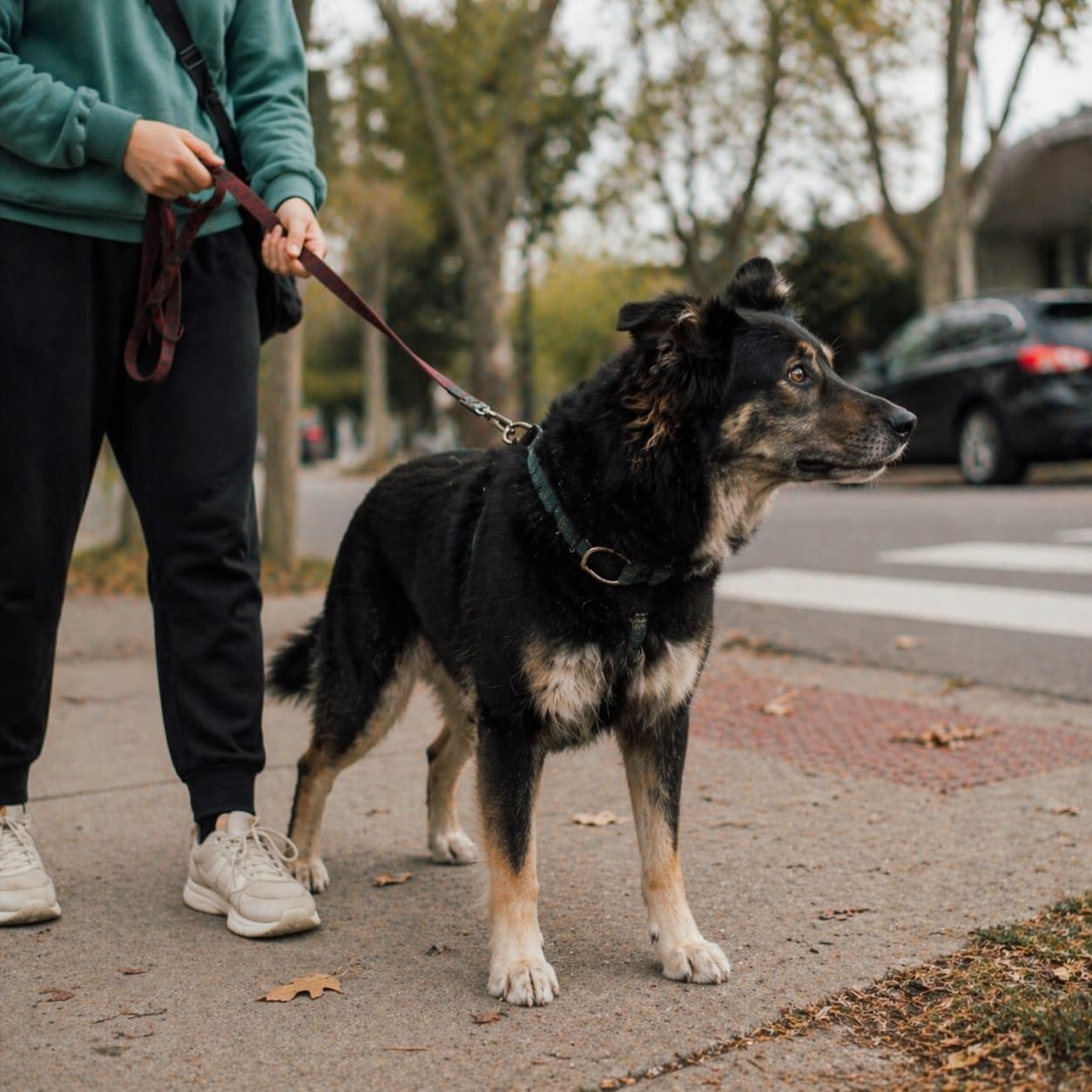
You see another dog a block away. Your dog spots it at the same moment, and the world narrows. The leash tightens. The ears pin. And the barking starts — that particular bark, the high, frantic one that everyone on the street turns around for. You apologize into the air. You cross. You wonder, for the thousandth time, why does my dog do this?
Here's the answer, in order of likelihood — because the cause matters a lot for what fixes it.
Use this as a first-pass read, not a diagnosis. Body language, history, and trigger context matter more than one bark.
| Pattern | What it often looks like | What to do first |
|---|---|---|
| Fear / distance-seeking | Tight mouth, hard stare, pinned or forward ears, barking that creates space. | Increase distance, stop greetings, use LAT below threshold. |
| Frustrated greeter | Forward, bouncy, whiny, wants to reach the dog, often social off leash. | Build impulse control, avoid on-leash greetings, reward disengagement. |
| Trigger stacking | The dog reacts bigger than usual after a busy day, poor sleep, or prior trigger events. | Reduce walk difficulty for 24-72 hours and prioritize decompression. |
The #1 reason: your dog wants distance
For the vast majority of dogs who bark and lunge at other dogs on leash, the translation of the behavior is one sentence: "please go away."
This is the single most important thing to internalize, because it flips the usual story. Your dog isn't trying to fight. Your dog isn't asserting anything. Your dog is, in dog language, asking a stranger to leave — loudly, because quiet requests (freezing, hard stare, tight mouth) didn't work in the past, and loud ones did.
From your dog's perspective, the bark-and-lunge has worked its entire life. Every time your dog barked at a dog across the street, the other dog eventually went away. Whether it went away becauseof the bark is irrelevant — from a learning standpoint, the bark and the distance are paired. So the bark gets stronger.
The second reason: frustration, not fear
A smaller group of dogs barks at other dogs for the opposite reason: they want to go say hi, can't, and the leash is the obstacle. This is called frustrated-greeter behavior, and it looks almost identical to fear-reactivity, with one tell: the dog's body is forward and loose, not forward and tight. Their barking has a whiny, almost pleading quality. Off leash, with the other dog, they would be friendly.
This matters because the intervention is slightly different. Fear-reactive dogs need distance; frustrated greeters need impulse control and leash-free social outlets. Mix them up and you train the wrong thing. If you are unsure which pattern you are seeing, use the comparison in fear reactive vs frustrated greeter before choosing a protocol.
The third reason (often missed): stack
Some dogs bark at every dog because their stress budget is already overdrawn before the walk starts. A dog that's had a loud morning, poor sleep, a vet visit two days ago, and no decompression in 48 hours will react to things it would have ignored last Tuesday. It looks like "my dog is getting worse," but it's usually "my dog's nervous system is saturated." Once you log a week of walks alongside household events, the pattern tends to jump out. We wrote a full explainer in what trigger stacking is.
What the bark is not
A short list, because these are the stories that waste the most years:
- It's not dominance. Dominance as a framework for dog behavior has been rejected by every major US behavior organization (AVSAB, APDT, IAABC). Even the author of the original wolf study (Mech, 1999) walked it back.
- It's not stubbornness.Dogs don't have the metacognition to "hold out" against a lesson. If the behavior persists, the learning conditions are wrong — not the dog.
- It's not aggression. True dog-aggression is rare and looks different: silent, targeted, damage-focused. Reactivity is loud, chaotic, panic-driven. They feel similar from the handle of a leash but they are not the same thing.
Why the usual fixes fail
Most advice for barking-at-dogs is aimed at suppressing the bark. A sharp "NO," a leash pop, a prong, a shock. These can reduce the bark frequencyin the short term, because the dog is weighing "bark and get corrected" against "stay quiet." But the underlying emotion — the wanting distance — is untouched. And worse: now the dog has learned that other dogs predict pain, in addition to whatever it was already feeling. Long-term outcomes get worse, not better. This is the consistent finding across every peer-reviewed review we know of (Ziv 2017; Vieira de Castro 2020).
The second most common advice — "just walk past more dogs, they'll get used to it" — is functionally worse. Walking a reactive dog past lots of triggers practices the reaction. Every successful bark reinforces the next one. Cortisol stacks (see trigger stacking), threshold shrinks, and the dog's world gets smaller.
What actually works
Three moves, ordered. None of them are complicated.
1. Work below threshold.
Figure out the distance at which your dog can see another dog and still eat a treat. That's your working distance today. Not closer — not one step. If the only place you can find that distance is an empty parking lot at 6 a.m., that's the training ground. Anywhere closer is just rehearsal.
2. Use LAT (Look At That).
The moment your dog sees another dog at working distance, mark it ("yes!") and feed. Repeat. Over weeks, your dog starts offering the look-and-return on its own: "Dog — handler — treat." You are literally rewriting the emotional prediction. This is classical counter-conditioning, and it's the most studied intervention for reactivity we have. For the full protocol, see what LAT training is.
3. Budget the stack.
On days when your dog is already stacked, don't train. Do a sniff walk. Do a decompression day. Accept that a 10-minute quiet yard is worth more than a 40-minute walk past four dogs today. Save the training reps for when your dog is below threshold and has the budget.
Next-walk checklist
- Pick a route with exits: parked cars, side streets, driveways, or open grass.
- Start at a distance where your dog can still take food and turn their head.
- Mark the first notice of another dog, then feed before fixation builds.
- Turn away after one clean rep instead of staying until the situation gets harder.
- Log trigger type, distance, intensity, and recovery time when you get home.
If you do these three things, what happens?
In our experience, and in the research literature, most owners see first-noticeable change in 2–4 weeks (see a realistic desensitization timeline). The first time your dog looks at another dog and then checks in with you, unprompted — you will remember the exact corner. That's the moment. Everything after is compounding. For whether reactivity ever fully goes away, read can a reactive dog be "cured" — the short version is: transformed is the honest goal.
If you need a practical starting point rather than another explanation, start with the 7-day reactive dog training plan.
Evidence basis
This article is grounded in humane, reward-based behavior guidance and PawZen's science page.
Quick answers
Is barking at other dogs the same as aggression?
Not usually. Barking and lunging on leash is often a distance-increasing behavior, frustration, or stress stacking. True aggression is more targeted and safety-critical, so get professional help if there is bite history or redirected biting.
Should I stop walks if my dog barks at every dog?
Do not stop all movement, but stop rehearsing hard walks. Use quieter routes, shorter sniff walks, and distance-based training until your dog can notice a trigger and still eat, think, and recover.
Why is my dog fine at daycare but reactive on leash?
Daycare and leash walks are different contexts. Off leash, the dog can move freely; on leash, distance and greeting choices are restricted. Some dogs also learn at daycare that every dog is available for greeting, which makes leash frustration worse.
Related reading
- My Dog Lunges at Other Dogs: What to DoLunging is loud, physical, and embarrassing. It is also information: your dog is too close, too aroused, or too overwhelmed for the current setup.
- Reactive vs Aggressive Dog: Key DifferencesBarking and lunging can look scary from the outside. But reactivity and aggression are not the same thing, and the difference changes what you do next.
- Fear Reactive vs Frustrated Greeter: Key SignsTwo dogs can bark, lunge, and embarrass you in exactly the same way for opposite reasons. One wants distance. One wants access. Mixing them up is how good owners train the wrong thing.
Start your free assessment
Get a personalized training plan based on your dog — not a generic protocol.
Optional: notify me when the 30-Day Calm Walk Reset program opens (not required to use the free app).