Reactive Dog Training Plan for the Next 7 Days
If walks feel chaotic, don't start with a bigger theory. Start with seven calm days: fewer rehearsed reactions, cleaner distance, short LAT reps, and a simple way to tell whether the plan is working.
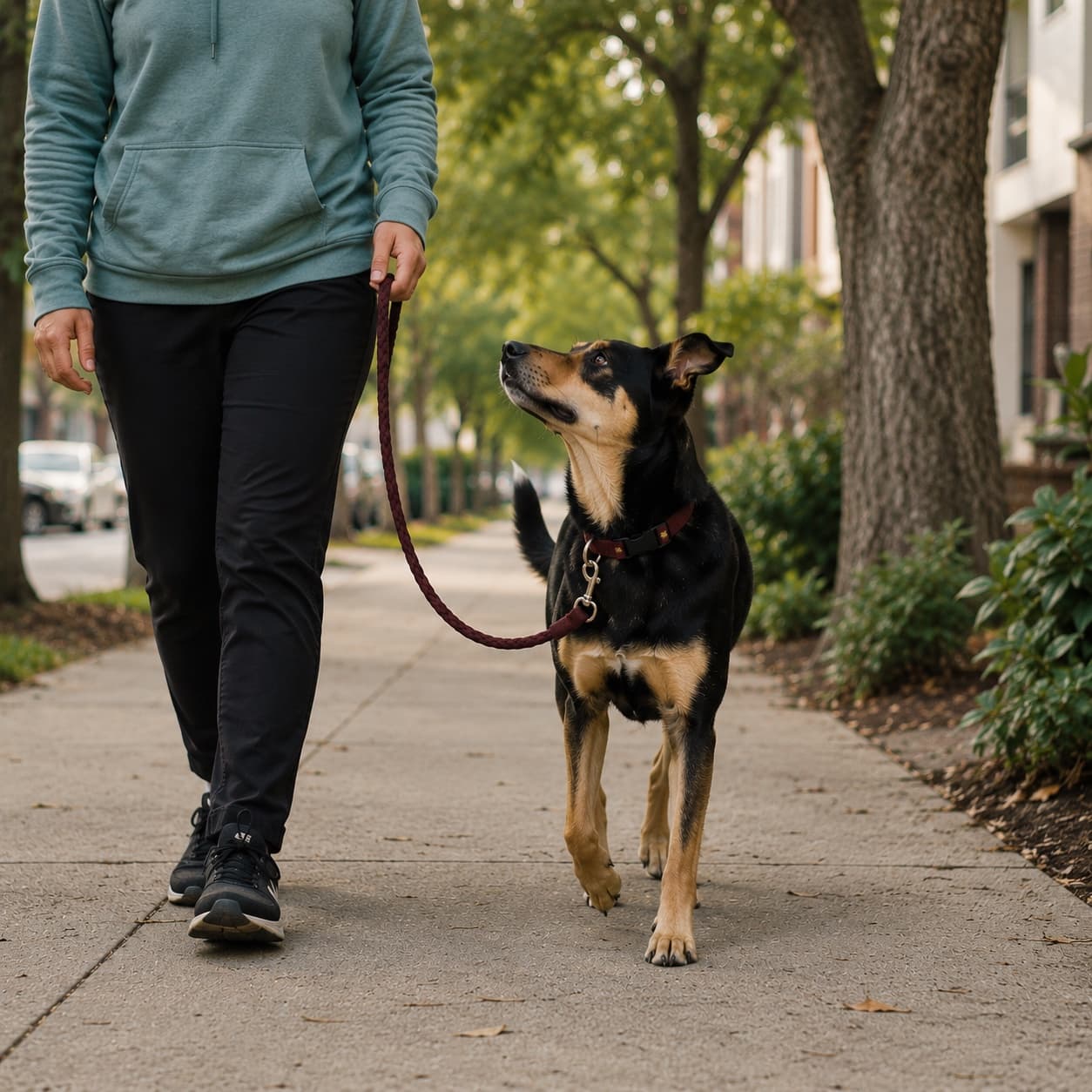
If your dog is reactive on walks, the first week is not about fixing the whole problem. It is about making the problem trainable. That means fewer rehearsed reactions, clearer working distance, shorter sessions, and enough recovery that your dog can actually learn.
This 7-day plan is deliberately boring. Boring is the point. Reactivity changes when the daily loop becomes predictable enough for the nervous system to stop bracing.
Reactive dog training plan for the next 7 days
Use the plan as a reset week. If your dog has a full over-threshold reaction, repeat the previous easier day instead of pushing forward.
| Day | Goal | What to do |
|---|---|---|
| Day 1 | Stop rehearsals | Choose the quietest route and log triggers, distance, intensity, and recovery. |
| Day 2 | Find working distance | Look for the distance where your dog can notice a trigger and still eat. |
| Day 3 | Practice exits | Do U-turns, side-street exits, and find-it games before you need them. |
| Day 4 | Add LAT | Mark the first glance at a trigger, feed, and leave after a few clean reps. |
| Day 5 | Protect recovery | Make the walk easier if sleep, stress, guests, weather, or prior triggers stacked. |
| Day 6 | Repeat the best setup | Do the same route, same time, same distance, and compare recovery time. |
| Day 7 | Review the trend | Decide whether to repeat the week, lower difficulty, or add one small challenge. |
Before day 1: lower the bar
Most owners begin by asking for too much. They want the dog to pass another dog calmly, walk the normal route, ignore surprises, and respond to cues while already over threshold. That is not training. That is a test the dog is not ready to pass.
For one week, your job is to make the walk easier than your ego wants it to be. If that means a 12-minute sniff walk at 6 a.m., that is the plan. You are building the baseline described in a realistic desensitization timeline, not proving your dog can cope with your hardest route.
How to find your dog's threshold distance
Threshold distance is the distance where your dog can notice the trigger and still eat, turn, sniff, or respond to an easy cue. It changes by day and by trigger. A calm older dog across the street may be workable. A staring adolescent dog on a narrow sidewalk may be too hard from much farther away.
Use the dog in front of you, not a fixed number of feet.
| Dog response | What it means | Next move |
|---|---|---|
| Can eat and disengage | The dog is under threshold enough to learn. | Mark the first notice, feed, and leave after a few clean reps. |
| Can stare but still take food | The setup is close to the edge. | Increase distance before repeating. |
| Refuses food or stiffens | Stress is already too high for useful reps. | Exit and make the next exposure easier. |
| Barks, lunges, or redirects | The dog is over threshold. | Stop training, create safety, and add recovery time. |
What counts as a successful day?
Not perfection. A successful day is one where the dog rehearses the old behavior less and rehearses one better choice more. That better choice might be tiny: a head turn, a sniff after seeing a dog, a faster recovery, or eating after a trigger passes.
Green lights to continue
- Your dog can take food before, during, or shortly after seeing a trigger.
- Recovery is faster than the last comparable walk.
- You can create distance before the bark becomes a lunge.
- The dog checks in once without being cued.
- The next walk does not start at a higher arousal level.
What to do if a day goes badly
A bad day does not mean the plan is ruined. It means the next setup must be easier. Most owners lose progress by trying to make up for the bad walk with a harder training session. Reactive dogs usually need the opposite: lower trigger density, more sniffing, and a shorter goal.
Red flags that the plan is too hard
If your dog is reacting every day, the plan is not failing because it is too gentle. It is failing because the setup is too difficult. Go back to management: easier route, more distance, shorter walk, more recovery. For dogs who bark at every dog, the first win is often described in why dogs bark at every dog on walks: finding enough distance that thinking comes back online.
Lower difficulty if you see
- Your dog refuses high-value food before the trigger is close.
- Recovery takes more than a few minutes after most encounters.
- Your dog scans constantly and cannot sniff.
- You are relying on leash tension to hold the dog together.
- One bad walk turns into a bad next day.
When to add the next challenge
Add difficulty only when your dog has had several comparable walks with faster recovery and fewer rehearsed reactions. The next challenge should be small: the same route at a slightly busier time, one controlled dog at a larger distance, or one extra minute of calm observation before you leave.
If your dog is lunging at other dogs, do not use the lunge as the training moment. Pair this plan with the lunging-specific guide so the next challenge is built around prevention, not correction.
Where PawZen fits
PawZen is built around this exact problem: the six days between big advice and the next real-life walk. Your trainer can give strategy. PawZen turns the daily pattern into a plan: what difficulty today can handle, what to log, and whether the trend is moving.
Evidence basis
This article is grounded in humane, reward-based behavior guidance and PawZen's science page.
Quick answers
Can I train leash reactivity in one week?
You can start changing the pattern in one week, but you should not expect the reactivity to be fixed. The first week is about reducing rehearsals, finding working distance, and building a repeatable daily loop.
How long should each reactive dog training session be?
Five to ten minutes is enough for most dogs. Stop after a few clean repetitions or before the trigger gets harder. Frequency matters more than long sessions.
What if my dog reacts during the 7-day plan?
Treat it as data. Increase distance, lower the next walk difficulty, and give the dog recovery time. One reaction does not ruin the week, but repeated hard reactions mean the setup is too difficult.
Should I walk my reactive dog every day?
Most reactive dogs still need movement, but not every day should be a full neighborhood walk. Use short potty breaks, sniff walks, quiet routes, or decompression days when your dog is already stressed.
How do I find my dog threshold distance?
Start far enough away that your dog can notice the trigger and still eat, turn, sniff, or recover quickly. If the dog refuses food, stiffens, barks, or lunges, you are too close or the setup is too hard.
What should I do after a bad training day?
Treat it as data. Lower the next walk difficulty, shorten the route, add recovery time, and repeat the last successful day instead of pushing forward.
Related reading
- How to Walk a Reactive Dog: Step-by-StepA good reactive dog walk is planned before the leash clips on. The goal is not to survive the hardest route. It is to stack small, recoverable wins.
- Counter-Conditioning for Dogs: Step by StepCounter-conditioning is not bribery. It is a structured way to make a trigger predict something good before your dog is too overwhelmed to learn.
- What is LAT training? The most underused tool for reactive dogs.LAT is deceptively simple: mark the instant your dog sees a trigger, then pay. Done right, it rewires the emotional response from 'threat' to 'predictor of good things.' Done wrong, it's just an expensive way to feed your dog in front of scary stuff.
- Best Treats for Reactive Dog TrainingIf your dog will not take treats outside, the food may be boring. But more often, the setup is too hard. Treat choice and threshold distance work together.
Start your free assessment
Get a personalized training plan based on your dog — not a generic protocol.
Optional: notify me when the 30-Day Calm Walk Reset program opens (not required to use the free app).