Dog Reactive on Leash but Fine Off Leash: Why?
A dog can be social in daycare and still fall apart on leash. That is not hypocrisy. It is context: restricted movement, leash tension, blocked greetings, and a walk environment your dog cannot control.
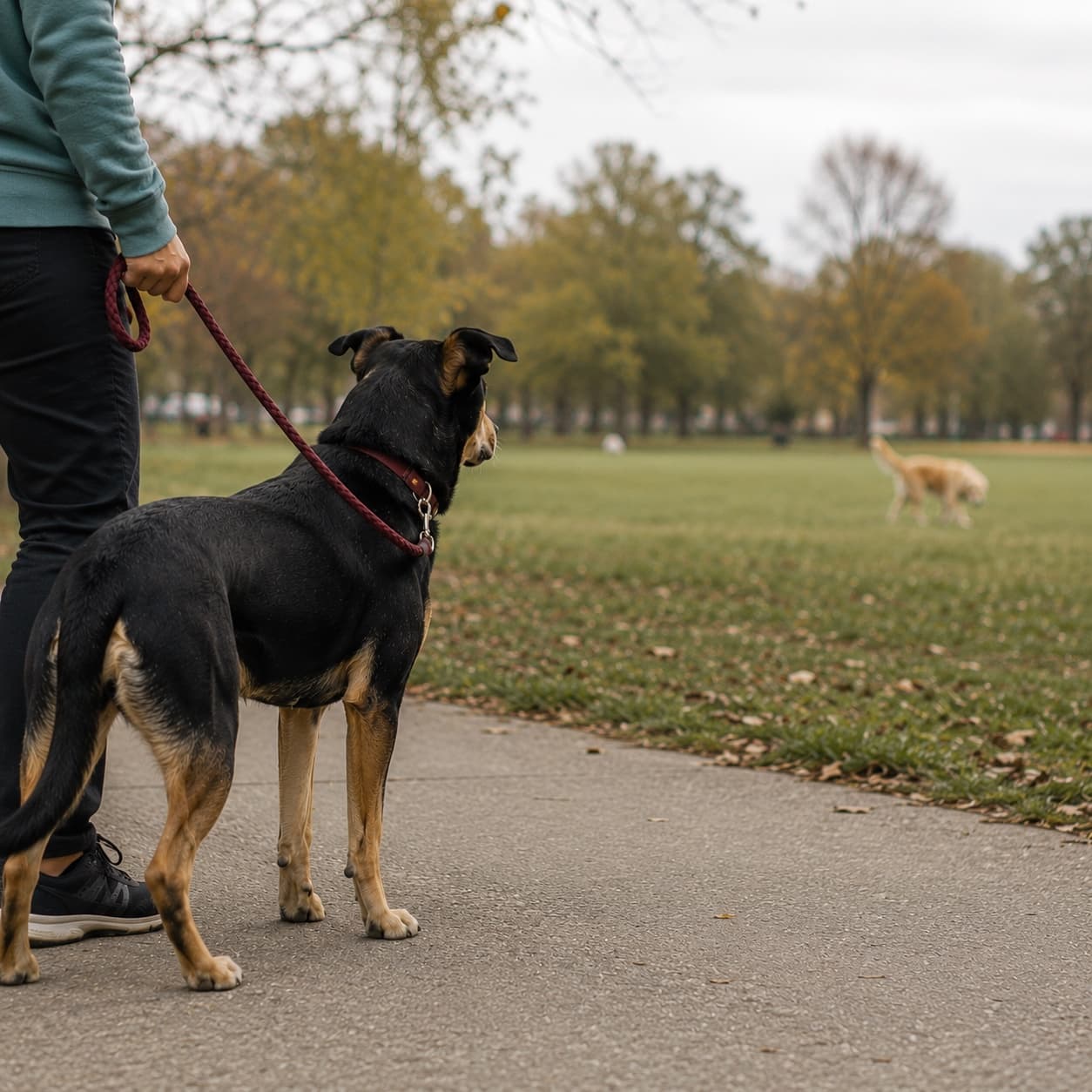
This is one of the most confusing reactive-dog patterns: your dog plays at daycare, has dog friends, or seems fine off leash, but on walks they bark and lunge like they have never met another dog in their life.
In search terms, the problem is simple: dog reactive on leash but fine off leash. In real life, it is more nuanced. The leash changes movement, distance, pressure, greetings, and the choices your dog can make.
That contradiction is the clue. The dog is not lying. The leash context changes the emotional math.
Why a dog can be reactive on leash but fine off leash
Off-leash behavior gives useful information, but it does not cancel out leash reactivity.
| Context | What changes | Why it matters |
|---|---|---|
| Movement | Off leash, the dog can arc, slow down, retreat, or choose distance. | On leash, flight options shrink, so barking can become the distance tool. |
| Greetings | Daycare often means dogs are available for access. | Walks block access, which can create frustrated greeting. |
| Leash tension | A tight leash changes posture and pressure. | Tension can add arousal and make the other dog feel more threatening. |
| Neighborhood context | Near home, the dog may be more vigilant or rehearsed. | The same dog may cope better in neutral spaces. |
The leash removes options
Dogs do not greet in straight lines because straight lines are socially intense. Off leash, a dog can curve, pause, sniff, look away, or leave. On leash, especially on a narrow sidewalk, the dog is often pulled directly toward the trigger. If they want space and cannot get it, they may bark to create it.
That is why this pattern overlaps with dogs who bark at every dog on walks. The leash is not the whole cause, but it is often the condition that makes the old response fire.
Daycare can complicate the picture
Some dogs do well in daycare and still get worse on leash because daycare teaches a simple expectation: dogs are for access. Walks teach the opposite: dogs appear, the leash tightens, access is blocked, and frustration climbs.
That does not mean daycare is always bad. It means daycare is not the same skill as calm leash neutrality. A social dog still needs to learn that seeing a dog does not always mean greeting a dog.
What to change first
- Pause on-leash greetings for now, even if your dog is friendly.
- Use longer visual distance instead of trying to pass close.
- Reward your dog for seeing a dog and disengaging.
- Practice parallel movement with calm helper dogs instead of face-to-face greetings.
- Log whether reactions are worse near home, after daycare, or after blocked greetings.
How to tell if it is fear or frustration
If the dog is loose, bouncy, whiny, and desperate to get to the other dog, frustration may be the main driver. If the dog is tight, hard-eyed, pinned, low, or relieved when the other dog leaves, fear or distance seeking is more likely. Many dogs are mixed, so use the comparison in fear reactive vs frustrated greeter before choosing the next protocol.
| Owner instinct | Why it backfires | Better replacement |
|---|---|---|
| Let them say hi | The dog learns that pulling and escalating can earn access. | Reward calm noticing, then move away or parallel walk. |
| Demand a tight heel | Tension and restraint can increase arousal. | Use distance, movement, and easy pattern games. |
| Add more daycare | More access does not teach neutrality. | Balance social outlets with calm dog-in-view practice. |
Evidence basis
This article is grounded in humane, reward-based behavior guidance and PawZen's science page.
Quick answers
Does being fine off leash mean my dog is not reactive?
No. It means the reactivity is context-specific. Leash restriction, barrier frustration, neighborhood pressure, or repeated on-leash failures can create a different emotional state.
Should I allow on-leash greetings if my dog is friendly?
Usually no. On-leash greetings are hard to control and can increase frustration. Practice calm parallel movement and reward disengagement instead.
Can daycare make leash reactivity worse?
It can for some dogs. Daycare may teach that other dogs are always available for access, while leash walks teach the opposite. That mismatch can increase frustration.
Why is my dog only reactive on leash?
The leash removes normal options like curving away, slowing down, retreating, or greeting naturally. That restraint can create fear, frustration, or barrier pressure even in a dog who is social off leash.
Related reading
- Fear Reactive vs Frustrated Greeter: Key SignsTwo dogs can bark, lunge, and embarrass you in exactly the same way for opposite reasons. One wants distance. One wants access. Mixing them up is how good owners train the wrong thing.
- How to Walk a Reactive Dog: Step-by-StepA good reactive dog walk is planned before the leash clips on. The goal is not to survive the hardest route. It is to stack small, recoverable wins.
- Why does my dog bark at every dog on walks? A straight answer.Barking at every dog isn't defiance, isn't dominance, and isn't something you'll fix with a firmer hand. It's one of the most common — and most solvable — forms of reactivity, once you understand what it's actually saying.
Start your free assessment
Get a personalized training plan based on your dog — not a generic protocol.
Optional: notify me when the 30-Day Calm Walk Reset program opens (not required to use the free app).