Fear Reactive vs Frustrated Greeter: Key Signs
Two dogs can bark, lunge, and embarrass you in exactly the same way for opposite reasons. One wants distance. One wants access. Mixing them up is how good owners train the wrong thing.
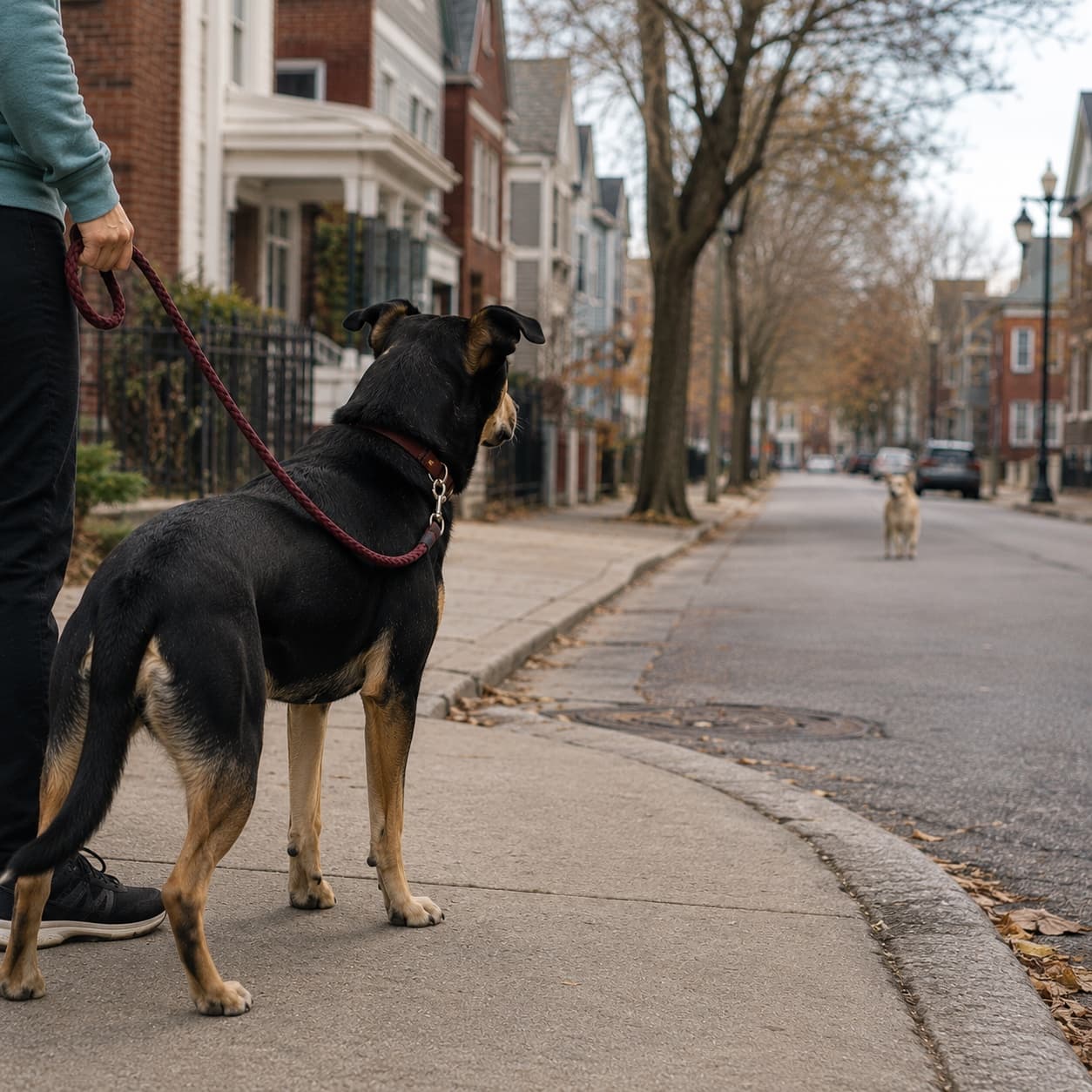
Fear reactivity and frustrated-greeter behavior can look almost identical from the handle of the leash: barking, lunging, pulling, spinning, and a human trying to disappear into the sidewalk. But the dog underneath those behaviors may be asking for opposite things.
A fear-reactive dog usually wants distance. A frustrated greeter usually wants access. If you mix them up, you can accidentally train the wrong skill.
Fear reactive vs frustrated greeter: quick comparison
This is a pattern-reading table, not a diagnosis. If there is bite history, redirected biting, or safety risk, work with a qualified professional.
| Clue | Fear reactive | Frustrated greeter |
|---|---|---|
| Body shape | Tight, low or forward-stiff, weight braced, mouth closed or tense. | Forward, bouncy, loose, whiny, body wants to move toward the dog. |
| Likely goal | Make the trigger go away. | Get to the trigger faster. |
| Off-leash history | May avoid, freeze, snap, hide, or need careful introductions. | Often social or playful once access is allowed. |
| First move | Increase distance and use counter-conditioning below threshold. | Stop on-leash greetings and reward disengagement/impulse control. |
Why this distinction matters
A fear-reactive dog needs safety first. That usually means distance, predictable exits, and protocols like LAT that change the emotional meaning of the trigger.
A frustrated greeter needs a different first layer: fewer chaotic greetings, more calm parallel movement, and reinforcement for seeing a dog without demanding access. The dog may not be scared, but the arousal is still real. Enough frustration can become a full over-threshold reaction. If your dog is social in freer contexts but falls apart on leash, read why a dog can be reactive on leash but fine off leash.
Most dogs are not perfectly one or the other
Mixed cases are common. A dog might be thrilled to see familiar dogs and worried by large unfamiliar dogs. Or a dog may start as a frustrated greeter and become fearful after months of leash tension, corrections, and bad greetings. This is why the answer lives in patterns, not labels.
Questions to ask before choosing a protocol
- What does my dog do when the trigger moves away?
- Is the body loose and forward, or tight and braced?
- Can my dog eat before the bark starts?
- Is the reaction worse when greetings are blocked?
- Does the same dog behave differently off leash, behind a fence, or near home?
The first protocol to choose
If you are not sure, choose the safer default: more distance, no on-leash greetings, and reward-based work under threshold. That helps both groups. A fear-reactive dog gets safety. A frustrated greeter gets practice seeing dogs without immediately getting access.
Then watch what improves. If distance and LAT quickly reduce intensity, fear or uncertainty was probably a big part of the picture. If the dog still screams mainly when blocked from greeting, the plan needs more impulse-control and calm-social-context work.
| If this is the pattern | Avoid | Try first |
|---|---|---|
| Fear / avoidance | Forcing greetings, tight passes, leash corrections near dogs. | Distance, LAT, decompression, controlled helper-dog setups. |
| Frustration / access-seeking | Letting lunging earn greetings, dog parks as the only outlet. | Parallel walks, calm settle near dogs, reward disengagement. |
| Mixed case | Assuming one label explains every trigger. | Track trigger type, distance, body language, and recovery. |
Evidence basis
This article is grounded in humane, reward-based behavior guidance and PawZen's science page.
Quick answers
Can a dog be both fearful and frustrated?
Yes. Many leash-reactive dogs are mixed cases. A dog may want to greet familiar dogs but feel threatened by unfamiliar or intense dogs, especially after repeated bad leash encounters.
Does a frustrated greeter need more greetings?
Usually no. More on-leash greetings often make the frustration stronger. The dog needs impulse control, parallel movement, calm social outlets, and reinforcement for disengaging.
Is fear reactivity more serious than frustration?
Both deserve care. Fear cases have more obvious welfare and safety risk, but frustration can escalate into panic, rehearsed lunging, or conflict if the dog keeps being held back at close range.
How do I know if my dog is a frustrated greeter?
Look for a loose, forward, bouncy dog who gets worse when access is blocked and often does well once calmly introduced. If the dog is tight, avoidant, or relieved when the trigger leaves, fear is more likely involved.
Related reading
- Reactive vs Aggressive Dog: Key DifferencesBarking and lunging can look scary from the outside. But reactivity and aggression are not the same thing, and the difference changes what you do next.
- What Is a Reactive Dog? Complete GuideA reactive dog is not a bad dog. Reactivity is an over-the-top response to something the dog finds scary, exciting, frustrating, or overwhelming. The first step is learning what problem you are actually training.
- What is LAT training? The most underused tool for reactive dogs.LAT is deceptively simple: mark the instant your dog sees a trigger, then pay. Done right, it rewires the emotional response from 'threat' to 'predictor of good things.' Done wrong, it's just an expensive way to feed your dog in front of scary stuff.
- Dog Reactive on Leash but Fine Off Leash: Why?A dog can be social in daycare and still fall apart on leash. That is not hypocrisy. It is context: restricted movement, leash tension, blocked greetings, and a walk environment your dog cannot control.
Start your free assessment
Get a personalized training plan based on your dog — not a generic protocol.
Optional: notify me when the 30-Day Calm Walk Reset program opens (not required to use the free app).